
Complete Guide to Choosing the Right Sign
The Complete Guide to Choosing the Right Sign
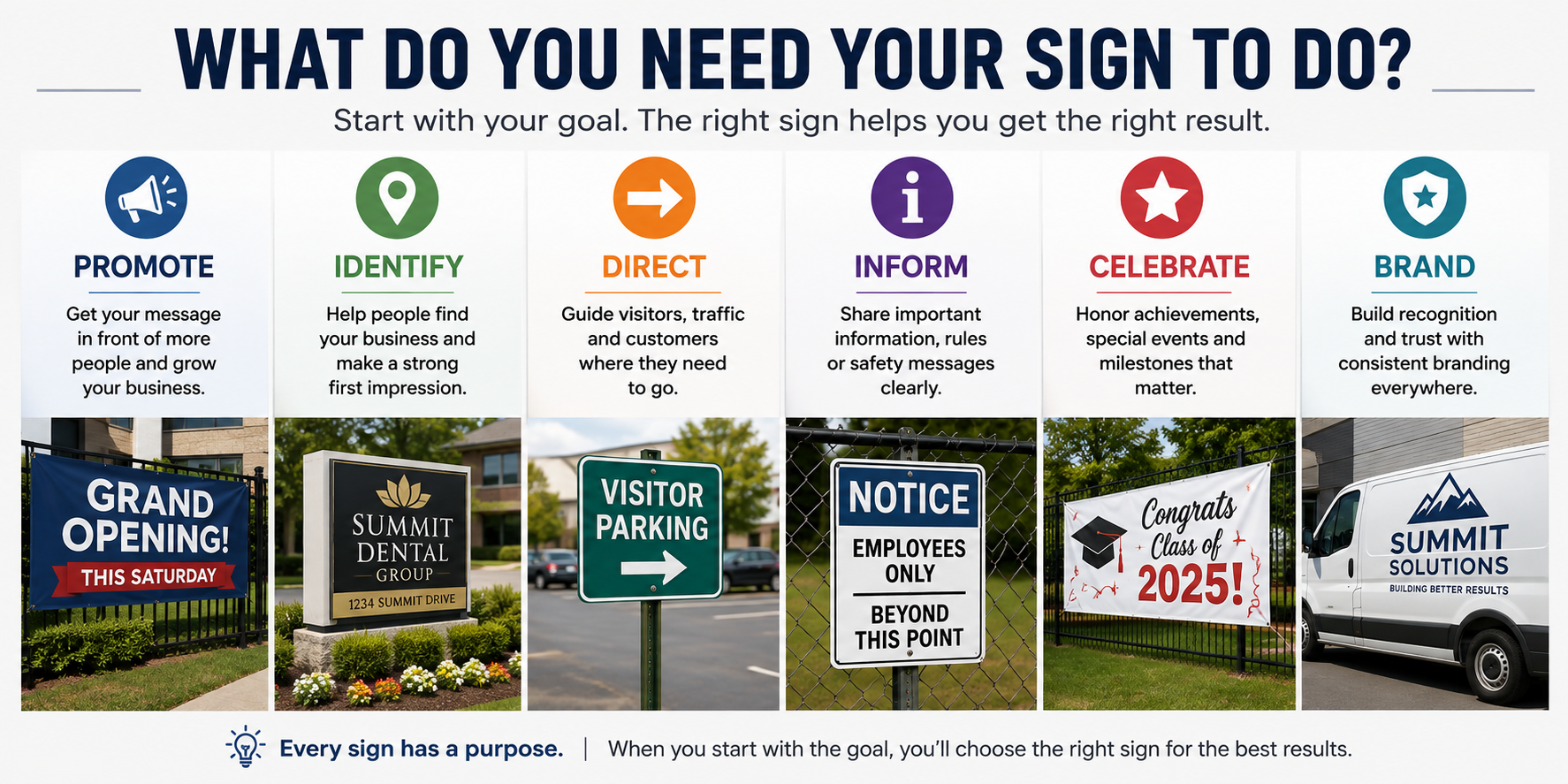
Choosing the right sign starts with a simple question: What do you need your sign to do?
Maybe you need to promote a sale, help customers find your business, direct traffic through a parking lot, advertise from your vehicle, celebrate an event, or create a permanent sign that represents your business for years to come. With so many sign types, materials, sizes, and installation options available, knowing where to begin can sometimes be the hardest part.
The good news is that you don't need to be a sign expert to make the right choice. Start by considering where your sign will be used, how long you need it, how far away people will see it, and what you want them to do after they see it. Those answers will quickly narrow down your options.
In this guide, we'll walk you through the most important decisions—from temporary versus permanent signage and choosing the right material to viewing distance, installation, and effective design. We'll also help you compare different types of signs so you can find the solution that best fits your business, event, property, or promotion.
And when you want to dig deeper, we'll point you toward our individual buying guides for products like yard signs, vinyl banners, vehicle magnets, and real estate signs, where you'll find more detailed information about choosing, designing, installing, and caring for each type of sign.
From the Sign Shop
Don't start by asking, “What sign should I buy?” Start by asking, “What do I need my sign to accomplish?” Once you know the goal, choosing the right sign becomes much easier.
Temporary or Permanent?
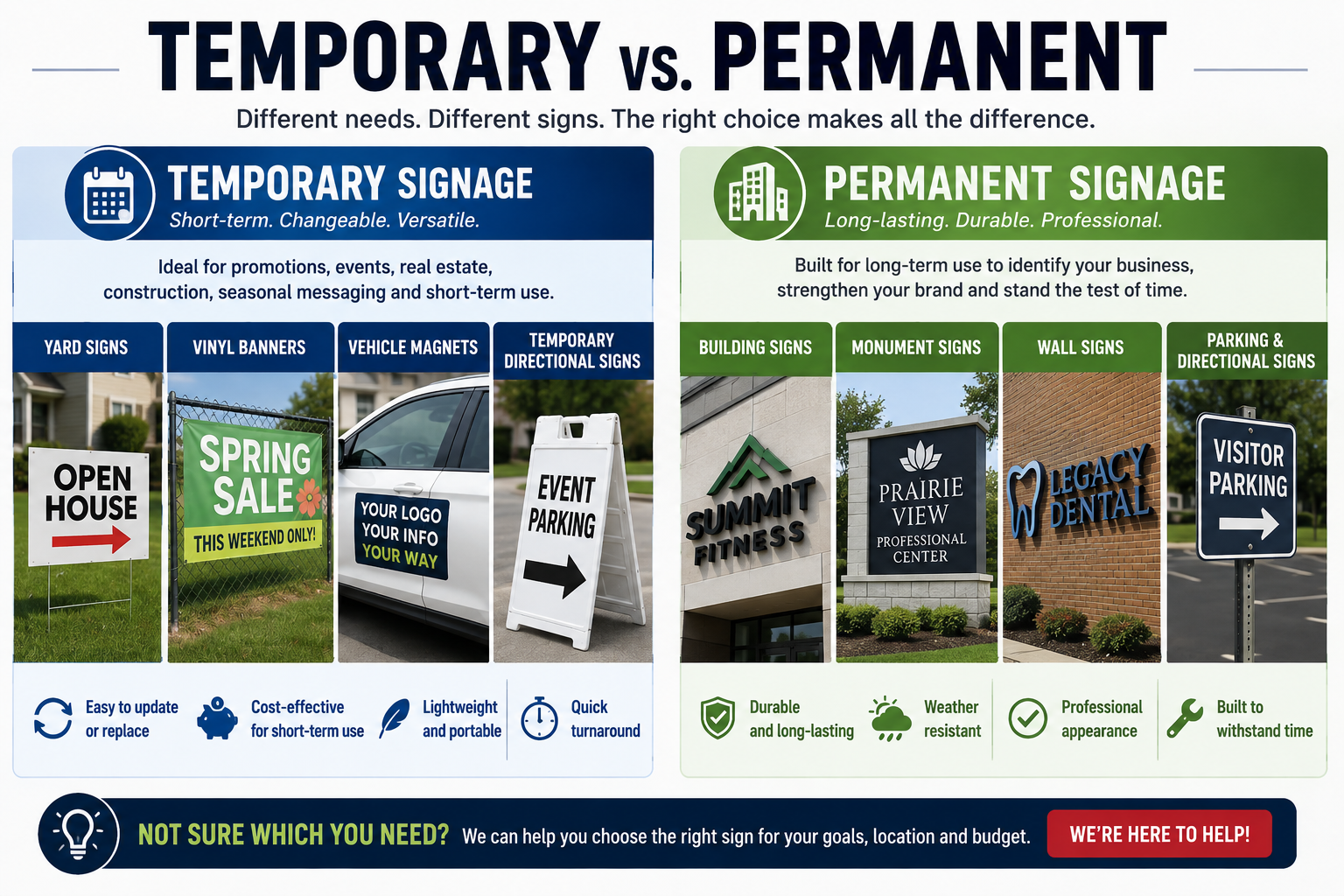
One of the first decisions to make when choosing a sign is how long you need it to do its job. Some signs are designed for a short-term promotion, event, or changing message, while others become a permanent part of your business or property.
Knowing whether your need is temporary or permanent helps narrow your choices and determines the materials, mounting method, and type of sign that will work best.
Temporary Signage
Temporary signs are a practical choice when your message has a limited lifespan or needs to move from one location to another. They're generally lightweight, easy to install, and simple to replace when your message changes.
Temporary signage works especially well for:
- Sales and promotions
- Special events
- Real estate listings and open houses
- Construction projects
- Seasonal advertising
- School and sporting events
- Temporary parking and directional needs
- Celebrations and announcements
Yard signs, vinyl banners, vehicle magnets, and temporary directional signs are all versatile options when you need visibility without committing to permanent installation.
Permanent Signage
Permanent signs are designed to provide long-term identification, branding, information, or wayfinding. They're typically constructed from more durable materials and may require posts, structural mounting, electrical connections, permitting, or professional installation depending on the type of sign.
Permanent signage is a good choice for:
- Business identification
- Storefronts and building exteriors
- Monument and ground signs
- Property entrances
- Long-term parking and directional signage
- Office and facility identification
- Permanent vehicle branding
Because these signs often represent your business for years, durability, visibility, design, location, and installation should all be considered before making your final choice.
What If You Need Both?
Many businesses do—and the two work very well together.
A permanent building or monument sign establishes your location and brand every day, while temporary yard signs and banners can advertise a grand opening, seasonal promotion, special event, or new service. A permanently branded work vehicle might even use temporary signage elsewhere at a job site.
The question isn't always temporary or permanent. Sometimes the best signage plan uses both.
From the Sign Shop
Think about the lifespan of the message, not just the lifespan of the material. If the information will change in a few weeks or months, a flexible temporary sign may make more sense. If the sign needs to represent your business year after year, investing in a permanent solution is usually the better choice
Where Will Your Sign Be Used?
Where your sign will be displayed has a major impact on the type of sign, material, size, design, and installation method you should choose. A sign hanging inside a business has very different requirements from one mounted outside along a busy road.
Start by considering whether your sign will be used indoors or outdoors, and then think about the conditions it will face and how your audience will see it.
Indoor Signs
Indoor signs are generally protected from rain, wind, direct sunlight, and other outdoor conditions, which gives you more flexibility when choosing materials and designs.
Because indoor signs are often viewed from a shorter distance, they can also include more detailed information than signs intended to be seen from the road.
Indoor signage can be used for:
- Lobby and reception areas
- Retail displays and promotions
- Office and facility identification
- Directional and wayfinding signs
- Event and trade show displays
- Informational and instructional signage
- Window and wall graphics
Consider viewing distance, available space, mounting surface, and whether the sign will be permanent or temporary when choosing an indoor sign.
Outdoor Signs
Outdoor signs need to do more than look good. They must perform in an environment that may include sunlight, rain, wind, temperature changes, and everyday exposure to the elements.
Material and installation become especially important outdoors. A temporary corrugated plastic yard sign has very different requirements from a permanent monument or building sign, even though both may be used at the same property.
Outdoor signage includes:
- Yard signs
- Vinyl banners
- Real estate signs
- Parking and directional signs
- Building and storefront signs
- Monument and ground signs
- Construction and job-site signage
- Exterior window and vehicle graphics
Think about weather exposure, how long the sign will remain outside, how it will be mounted, and how far away people will be when they see it.
Consider the Viewing Distance
Location isn't just about indoor versus outdoor. You also need to consider where your audience will be when they see the sign.
Someone walking through a lobby may have plenty of time to read detailed information. Someone driving past your business has only a few seconds.
As viewing distance increases, your sign generally needs:
- Larger lettering
- Fewer words
- Stronger color contrast
- A simpler message
- A clear visual hierarchy
The goal is to make the most important information easy to understand from the distance where your audience will actually see it.
From the Sign Shop
Design for the real viewing environment—not how the sign looks on your computer screen. Consider where it will be installed, what conditions it will face, how quickly people will pass it, and how far away they'll be. A sign only works if the people you're trying to reach can actually see and understand it
How Far Away Will People See It?
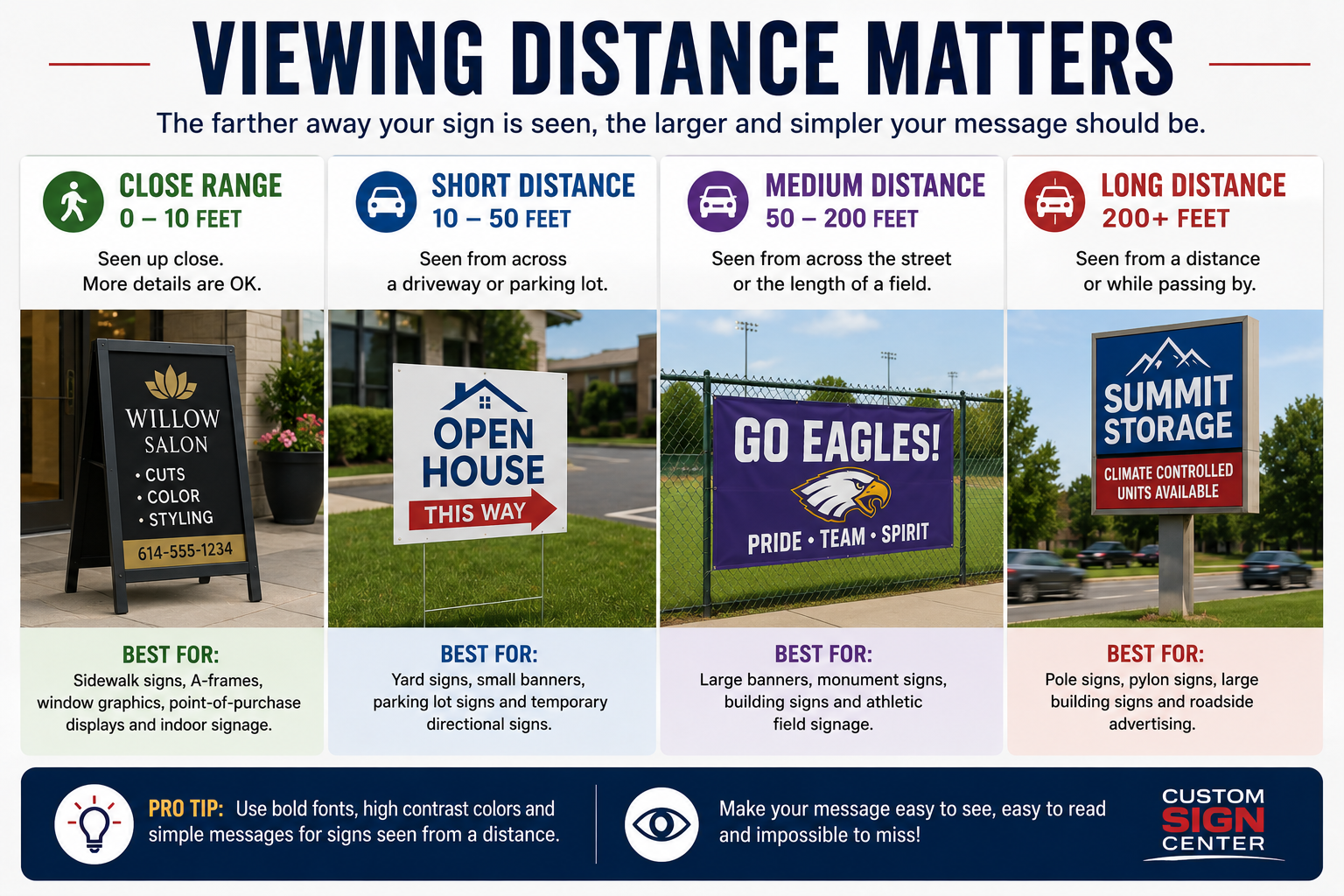
A sign can have the perfect message and a great design, but it won't accomplish much if people can't read it from where they'll actually see it. Viewing distance should influence your sign size, lettering, amount of information, and overall design.
Before ordering, think about where your audience will be. Will they be standing a few feet away, walking past your sign, driving through a parking lot, or seeing it from across a field or roadway?
Close-Range Viewing
Signs viewed from just a few feet away can include more information and smaller design elements because your audience has an opportunity to stop and read.
This works well for:
- Indoor informational signs
- Lobby and office signs
- Counter and retail displays
- Window graphics
- Notices and instructions
Even at close range, keep the design organized so the most important information is easy to find.
Short-Distance Viewing
Signs placed along sidewalks, entrances, storefronts, or smaller parking areas need to communicate more quickly.
This is where you'll often find:
- Yard signs
- Real estate signs
- A-frame signs
- Parking signs
- Entrance and directional signs
Use clear lettering, good contrast, and a message that can be understood without requiring someone to stop and study the sign.
Medium-Distance Viewing
When a sign needs to be seen from across a parking lot, athletic field, large property, or event space, size and simplicity become increasingly important.
Vinyl banners, larger directional signs, building signs, and sponsor signage often fall into this category.
Keep the primary message large and limit supporting information to what's truly necessary.
Long-Distance & Roadside Viewing
Roadside signs have the toughest job. Your audience may be hundreds of feet away and moving past the sign at driving speed.
Building signs, monument signs, pole signs, and other large exterior signage should feature:
- Large, bold lettering
- Strong color contrast
- Simple graphics
- Very limited messaging
- An immediately recognizable business name or brand
A roadside sign is not the place for a paragraph—or a phone number that requires binoculars.
Consider Viewing Time, Too
Distance isn't the only factor. How long someone has to look at the sign matters just as much.
A pedestrian may have several minutes to notice and read a sign, while a driver may have only a few seconds. As viewing time decreases, simplify your message, use larger lettering, and make the most important information immediately clear.
From the Sign Shop
The farther away your audience is—and the faster they're moving—the simpler your sign should become. Prioritize one main message, make it large enough to read comfortably, and don't make customers work to figure out what you're trying to tell them.
Choose the Right Type of Sign
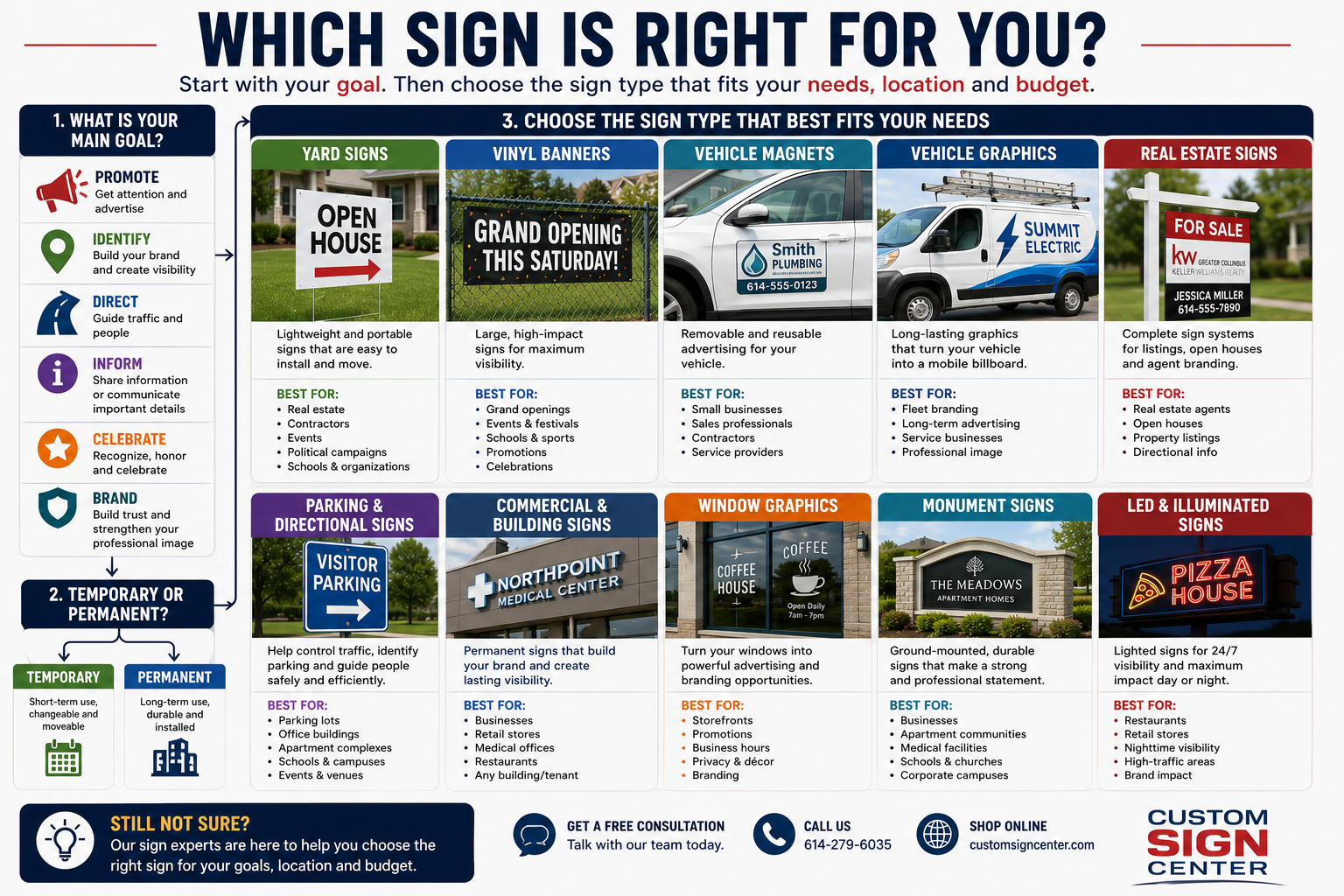
Once you know what your sign needs to accomplish, where it will be used, and how far away people will see it, choosing the right type of sign becomes much easier.
Different signs are designed to solve different problems. Some provide quick, affordable advertising, while others are built to identify and represent a business for years. The key is matching the sign to the job.
Yard Signs
Yard signs are an affordable and versatile choice for temporary outdoor advertising. They're lightweight, portable, and easy to place wherever your message needs to be seen.
Best for: contractors, events, schools, real estate, promotions, political campaigns, directional signage, and community announcements.
For help choosing sizes, stakes, materials, and designs, see our Complete Guide to Custom Yard Signs.
Vinyl Banners
Vinyl banners provide a large advertising area and can be used indoors or outdoors. They're especially useful when you need a message that's highly visible but doesn't require permanent installation.
Best for: storefront promotions, grand openings, schools, sports, sponsorships, construction sites, military welcome-home displays, celebrations, and special events.
Learn more about sizing, finishing, installation, design, and care in our Complete Guide to Custom Vinyl Banners.
Vehicle Magnets
Vehicle magnets provide removable advertising for cars, trucks, and work vehicles. They can be installed when you need them and removed when you don't, making them particularly useful for businesses using personal or multi-purpose vehicles.
Best for: contractors, service businesses, real estate professionals, delivery vehicles, small businesses, and temporary vehicle branding.
Our Complete Guide to Vehicle Magnets covers sizing, measuring, installation, care, and choosing between magnets and vehicle graphics.
Vehicle Graphics
Vehicle graphics provide a more permanent approach to mobile advertising. Lettering, logos, contact information, and custom graphics can transform a vehicle into a professional representation of your business wherever it travels.
Best for: work trucks, vans, commercial vehicles, service fleets, and businesses looking for long-term vehicle branding.
Real Estate Signs
Real estate signage is designed specifically to market properties, identify agents and brokerages, announce open houses, and direct potential buyers.
Options can include sign panels, riders, frames, L-posts, directional signs, and coordinated marketing materials.
Best for: residential and commercial listings, open houses, new developments, agents, teams, and brokerages.
For a deeper look at sizes, frames, riders, materials, design, and more, visit our Real Estate Sign Buying Guide.
Parking & Directional Signs
Parking and directional signs help people understand where to park, where to go, and what they need to know when they arrive at a property.
Best for: businesses, offices, schools, churches, apartment communities, events, construction sites, parking areas, and private properties.
Window Graphics
Windows are valuable advertising space that many businesses overlook. Custom window graphics can display branding, promotions, business information, or decorative designs without requiring additional sign structures.
Best for: storefront branding, business hours, sales and promotions, logos, services, privacy, and seasonal messaging.
Commercial & Building Signs
Permanent commercial signs establish a business's identity and help customers locate it. Depending on the property and application, solutions can include building signs, wall signs, dimensional lettering, monument signs, ground signs, illuminated signage, and other custom-fabricated signs.
These projects may also involve site evaluation, permitting, engineering, fabrication, electrical work, and professional installation.
Best for: storefronts, offices, restaurants, retail locations, healthcare facilities, industrial properties, developments, and other permanent business locations.
Sometimes the Best Solution Is More Than One Sign
You don't necessarily have to choose just one.
A new business might need a permanent building sign to identify its location, parking and directional signs to guide customers, window graphics for business hours, vehicle graphics for mobile advertising, and a temporary banner announcing its grand opening.
Each sign has a different job, but together they create a complete signage system.
From the Sign Shop
Match the sign to the job—not simply to the lowest price or the product you're most familiar with. Think about what the sign needs to accomplish, how long you'll use it, where it will be displayed, and who needs to see it. Those answers will usually point you toward the right solution.
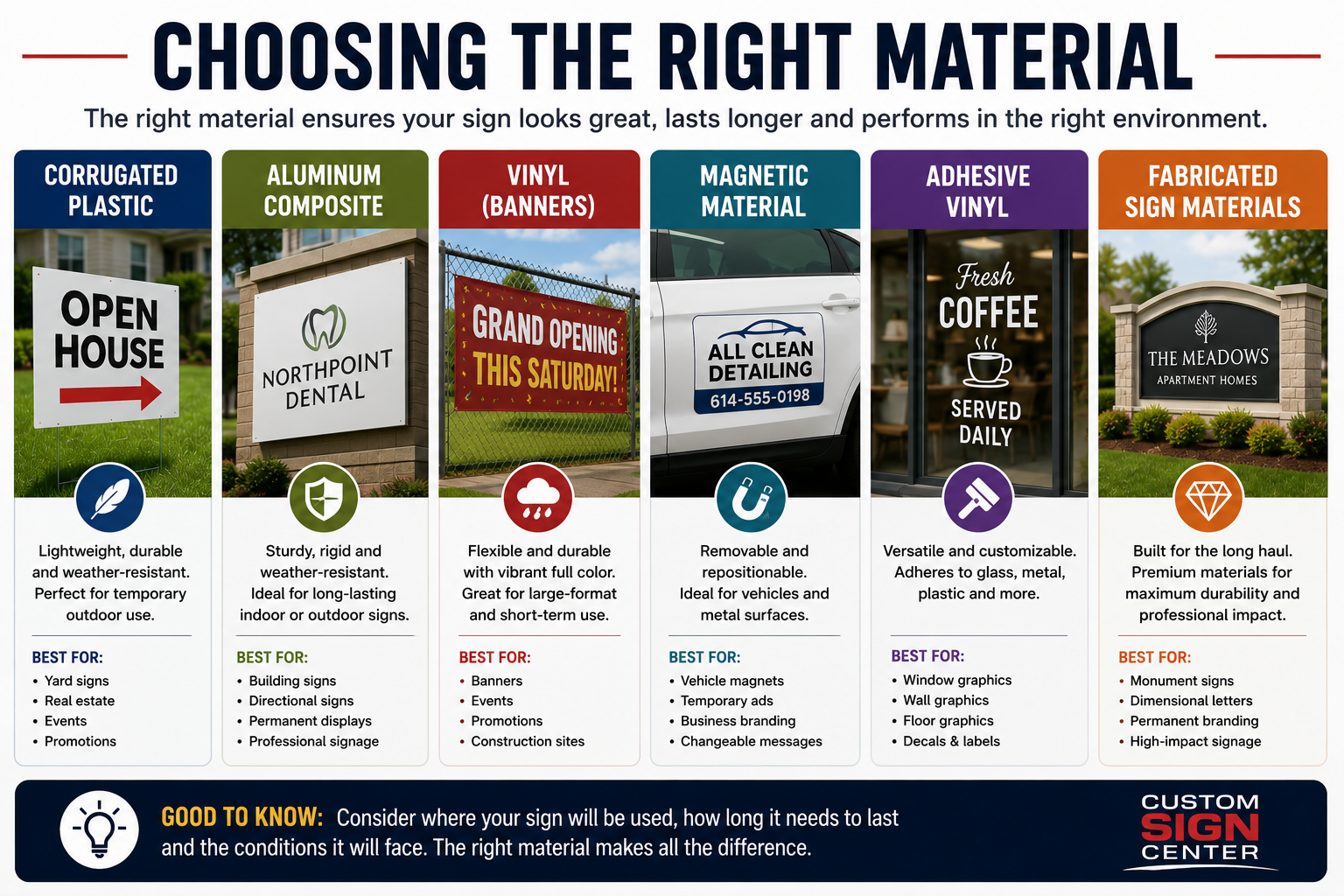
Choosing the Right Sign Material
The material your sign is made from affects its appearance, durability, weight, installation, and cost. But choosing the right material doesn't have to be complicated.
Instead of asking which material is “best,” consider where the sign will be used, how long you need it to last, how it will be installed, and what conditions it will face. The best material is the one that fits the job.
Corrugated Plastic
Corrugated plastic is lightweight, affordable, and versatile, making it one of the most popular materials for temporary signage. It can be paired with stakes for quick installation in lawns and other soft ground.
Best for: yard signs, real estate signs, contractor signs, events, political signs, temporary directional signs, and short-term promotions.
Aluminum Composite
Aluminum composite provides a rigid, smooth surface with excellent durability. It's a good choice when you need a more substantial sign for longer-term indoor or outdoor use.
Best for: parking signs, directional signs, property signs, business signs, informational signs, and other longer-term applications.
Vinyl Banner Material
Our 13 oz. scrim vinyl combines durability with flexibility and provides a smooth surface for vibrant full-color printing. Because banners can be rolled for transportation and storage, they're also convenient for recurring events and promotions.
Best for: banners, events, storefront promotions, schools, sports, sponsorships, celebrations, and large-format temporary advertising.
Magnetic Material
Magnetic material allows graphics and advertising to be applied to compatible metal vehicle surfaces without permanent adhesive. Magnets can be removed and reused when properly installed and cared for.
Best for: temporary or removable vehicle advertising, contractors, service businesses, real estate professionals, and businesses using personal vehicles for work.
Adhesive Vinyl
Adhesive vinyl can be applied directly to compatible surfaces and is available for a variety of applications. It provides a clean, professional appearance without requiring a separate sign panel or frame.
Best for: vehicle graphics, window graphics, lettering, logos, storefronts, and other applied graphics.
Fabricated Sign Materials
Permanent commercial signage may use a combination of materials selected specifically for the sign's design, location, structural requirements, illumination, and expected lifespan.
These projects can include aluminum, acrylics, dimensional lettering, illuminated components, structural supports, and other commercial sign materials depending on the application.
Best for: building signs, monument signs, ground signs, illuminated signage, dimensional lettering, and other permanent commercial installations.
Consider the Entire Application
Material shouldn't be selected in isolation. A material that's perfect for a temporary lawn sign probably isn't appropriate for permanent building identification—and a permanent fabricated sign would be overkill for a weekend event.
Consider:
- Indoor or outdoor use
- Temporary or permanent installation
- Weather exposure
- Required lifespan
- Size and viewing distance
- Mounting method
- Portability
- Budget
Balancing those factors will help you choose a material that performs well without paying for more sign than you actually need.
From the Sign Shop
Choose the material for the job—not the job for the material. Start with where the sign will be used, how long you need it, and how it will be installed. Once those questions are answered, the right material is usually much easier to identify
Think About Installation Before You Order
How a sign will be installed is just as important as the sign itself. The installation method can affect the cost, material, size, finishing options, hardware, and even the design, so it's worth thinking about before you place your order.
Start by looking at the location where the sign will be displayed. Knowing what the sign will attach to—or whether it needs its own support—can help prevent installation problems later.
Going Into the Ground
Yard signs and other temporary lawn signs can often be installed using stakes designed for the sign's size and material. Larger or more permanent ground signs may require posts, foundations, or professional installation.
Before ordering, consider the ground surface, sign size, expected length of use, and exposure to wind.
Hanging From a Fence or Structure
Vinyl banners can be attached to fences, railings, walls, and other secure structures using grommets and appropriate mounting hardware.
Make sure there are enough attachment points to distribute tension evenly. Don't rely only on the four corners, especially for outdoor installations.
Mounting to Posts or Frames
Real estate signs, parking signs, directional signs, and property signage may require posts or frames.
Check the sign size and hardware compatibility before ordering. A beautifully printed sign isn't much help if it doesn't fit the frame waiting for it.
Applying to a Vehicle
Vehicle magnets and adhesive vehicle graphics require different installation methods.
Magnets need a clean, smooth, magnet-compatible metal surface and should lie completely flat against the vehicle. Adhesive graphics require careful surface preparation and proper application for the best appearance and adhesion.
If you're unsure which option is right for your vehicle, consider whether you need the graphics to be removable or more permanent.
Applying to Windows
Window graphics can be installed directly onto compatible glass surfaces. Proper cleaning and surface preparation are important for good adhesion and a professional-looking result.
Before ordering, determine whether the graphic will be installed inside or outside the window, how it will be viewed, and whether you need visibility through any portion of the glass.
Permanent Commercial Installation
Building signs, monument signs, illuminated signs, and other permanent commercial signage can involve much more than simply attaching a sign to a wall.
Depending on the project, installation may require:
- Site evaluation
- Permits and zoning approval
- Engineering
- Structural supports
- Electrical connections
- Specialized equipment
- Professional installation
Planning for these requirements early helps ensure the sign is designed and manufactured appropriately for its final location.
Don't Forget the Hardware
Before completing your order, ask yourself:
Do I already have everything needed to install this sign?
Depending on the product, you may need stakes, frames, posts, mounting hardware, zip ties, rope, banner hardware, or another installation method.
It's much easier to order the correct hardware with your sign than to discover something is missing when you're standing outside ready to install it.
From the Sign Shop
Decide how the sign will be installed before deciding exactly what to order. The mounting surface, hardware, location, and installation method can influence nearly every other choice you make—from material and size to finishing and design.
Design for Where the Sign Will Be Seen
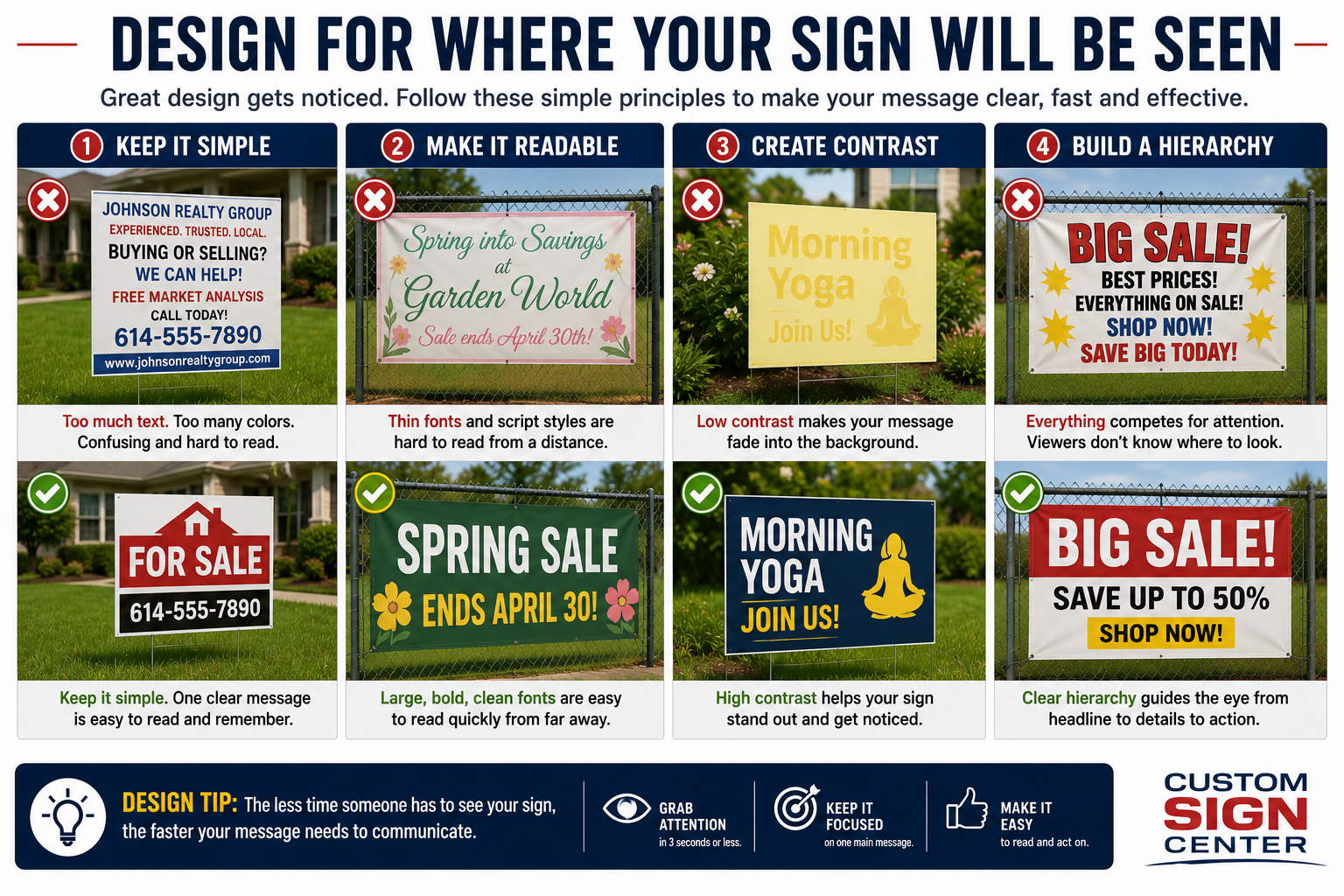
A good sign isn't simply attractive—it communicates effectively in the environment where people will actually see it. A design that works perfectly on a storefront window may not work on a roadside sign, and a banner viewed across an athletic field needs a very different approach from an informational sign inside a lobby.
Once you know where your sign will be displayed and how far away your audience will be, design it specifically for those conditions.
Keep the Message Simple
Every sign should have a clear purpose. Decide what you want people to notice first and make that the focus of the design.
Avoid trying to fill every available inch with information. Too much text forces everything to become smaller and makes the sign harder to understand quickly.
A strong sign often communicates one primary message with only the supporting information necessary to act on it.
Make It Easy to Read
Choose clean, readable fonts and make important information large enough for the expected viewing distance.
Decorative or script fonts can work as accents, but they're rarely the best choice for essential information that needs to be understood quickly.
Remember that a design that looks large on your computer screen can become surprisingly difficult to read once it's printed and installed.
Create Strong Contrast
Good contrast helps lettering and graphics stand apart from the background.
Dark lettering on a light background—or light lettering on a dark background—generally provides strong visibility. Be careful with colors that are too similar in value, even if they look attractive together.
The goal isn't simply to create a colorful sign. It's to create a sign people can read.
Establish a Clear Visual Hierarchy
Not everything on your sign should compete for attention.
Organize the information so viewers naturally see it in the right order:
Primary message → Supporting information → Call to action
Your business name, event, promotion, or main message should usually receive the greatest emphasis. Secondary information can then support it without overwhelming the design.
Use Images With Purpose
Photos, logos, and graphics can make a sign more memorable, but they should support the message rather than compete with it.
Use high-quality artwork and avoid adding images simply to fill empty space. A little breathing room can actually make the important elements more noticeable.
Consider How Quickly People Will Pass By
A person standing inside a business can stop and read. Someone walking past a storefront has less time. A driver traveling down the road may have only a few seconds.
As viewing time decreases:
- Use fewer words
- Increase lettering size
- Simplify graphics
- Strengthen contrast
- Focus on one message
Your audience shouldn't have to work to understand what your sign is telling them.
Include a Clear Next Step
If you're using the sign to advertise or promote something, decide what you want the viewer to do next.
That might be:
Call • Visit • Enter Here • Shop Now • Apply Today • Open House • Turn Here
Keep the call to action short, prominent, and appropriate for the situation. A complicated website address or lengthy phone message isn't particularly useful when someone is driving past at 45 mph.
From the Sign Shop
Design your sign for the person seeing it—not the person creating it. Step away from the computer screen and imagine the finished sign in its actual location. If the main message can't be understood quickly from the expected viewing distance, simplify it.
Don’t Forget Your Brand
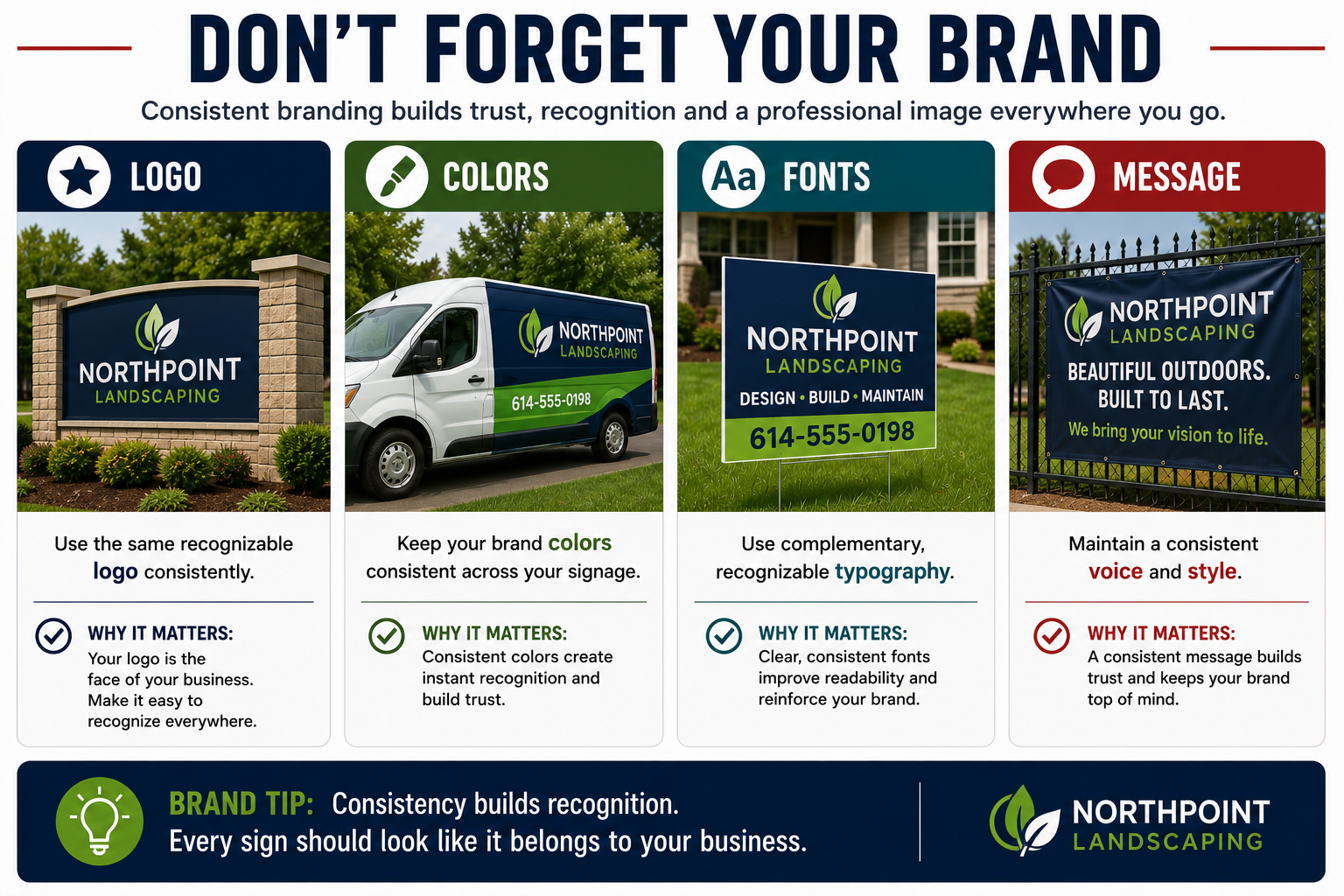
Every sign you put in front of a customer becomes part of your brand. Whether it's a permanent building sign, a vehicle graphic, a banner, or a temporary yard sign, it should look and feel like it belongs to the same business.
Consistent branding helps people recognize your company, remember it, and trust that they're dealing with an established professional business.
Use Your Logo Consistently
Your logo is often the most recognizable part of your brand, so use the same approved version across your signage whenever possible.
Avoid stretching, distorting, recoloring, or significantly changing the logo from one product to another. Consistent use builds familiarity and makes your marketing easier to recognize.
Stay Consistent With Your Colors
Brand colors provide an immediate visual connection between your signs, vehicles, storefront, website, and printed materials.
You don't necessarily need to use every brand color on every sign. Choose the colors that provide the best visibility and contrast while still maintaining a recognizable connection to your overall brand.
Keep Your Typography Familiar
Using the same or complementary fonts across your marketing helps create a cohesive appearance.
Readability still comes first—particularly on signs viewed from a distance—but your typography should feel like part of the same visual family rather than changing dramatically from one sign to the next.
Maintain a Consistent Message
Brand consistency goes beyond logos and colors. The tone, message, and overall impression should also feel consistent.
If your business presents itself as professional and dependable on your storefront, your yard signs, vehicle graphics, banners, and other advertising should reinforce that same impression.
Think Beyond a Single Sign
This is where branding really begins to work for you.
A customer might first see your truck on the road, later pass one of your yard signs, and eventually arrive at your storefront. If each of those looks completely different, you're missing opportunities for recognition.
When the same logo, colors, typography, and visual style appear repeatedly, those individual impressions begin to connect.
One business. One recognizable brand. Many places to be seen.
From the Sign Shop
Consistency builds recognition. You don't need every sign to look identical, but customers should be able to recognize that they all belong to the same business. Your logo, colors, fonts, and messaging should work together wherever your brand appears.
Common Sign-Buying Mistakes to Avoid
Ordering a sign may seem straightforward, but a few decisions made early in the process can have a big impact on how well the finished sign performs. Avoiding these common mistakes can save time, prevent unnecessary expense, and help ensure your sign does the job you intended it to do.
Choosing a Sign Based Only on Price
The least expensive option isn't always the most economical choice.
A temporary material may be perfect for a weekend event but a poor investment for a sign expected to remain outdoors for several years. Likewise, there's no reason to invest in a permanent sign material for a message that will only be relevant for a few weeks.
Choose based on purpose, location, and expected lifespan first, then consider the options that fit your budget.
Ordering a Sign That's Too Small
Signs often appear much larger on a computer screen than they do once they're installed.
Before ordering, measure the available space and consider how far away your audience will be. A sign intended for roadside viewing or a large property will usually need to be considerably larger than one viewed from a sidewalk or inside a business.
Trying to Include Too Much Information
A sign isn't a brochure.
Too much information creates visual clutter, forces important text to become smaller, and makes it harder for viewers to understand the message quickly.
Decide what someone must know and eliminate anything that doesn't help accomplish the sign's primary purpose.
Ignoring Viewing Distance
Lettering that looks perfectly readable while you're designing a sign may disappear once the finished product is installed.
Always design for the distance where your audience will actually see the sign—not how it appears while you're sitting in front of your computer.
Choosing the Wrong Material
Different materials are designed for different applications.
Consider whether the sign will be indoors or outdoors, temporary or permanent, exposed to weather, mounted to a structure, placed in the ground, or applied directly to another surface.
The right material helps your sign perform properly without paying for more—or settling for less—than you need.
Forgetting About Installation
Don't wait until your sign arrives to figure out how you're going to install it.
Consider whether you'll need stakes, frames, posts, grommets, mounting hardware, a compatible vehicle surface, or professional installation before placing your order.
For permanent commercial signage, permitting, engineering, electrical requirements, and installation may also need to be considered during the planning process.
Using Poor-Quality Artwork
A small image that looks sharp on a phone or computer screen may become blurry or pixelated when enlarged to sign size.
Use high-resolution photographs and quality logo files whenever possible. Vector artwork is especially useful for logos and graphics because it can be enlarged without losing quality.
Forgetting About the Weather
Outdoor signs need to be selected and installed with their environment in mind.
Rain, sunlight, temperature changes, and especially wind can affect different types of signage in different ways. Consider the expected exposure when selecting the material, mounting method, and location.
Temporary signs and banners should also be removed during severe weather whenever possible.
Making Every Sign Look Different
Your signs may perform different jobs, but they should still look like they belong to the same organization.
Changing logos, colors, fonts, and overall design from one sign to another weakens brand recognition. Maintain enough visual consistency that customers can connect your different signs and marketing materials to the same business.
Forgetting the Sign's Actual Purpose
This may be the biggest mistake of all.
It's easy to become focused on colors, materials, sizes, and products and lose sight of the original question:
What does this sign need to accomplish?
Every decision—from material and size to design and installation—should support that answer.
From the Sign Shop
The best sign isn't necessarily the biggest, most expensive, or most elaborate option. It's the sign that does its job well. Start with the purpose, consider the environment and audience, and make each decision from there.
Frequently Asked Questions About Choosing the Right Sign
How do I know what type of sign I need?
Start with the purpose of the sign. Are you trying to promote, identify, direct, inform, celebrate, or build your brand? Then consider where the sign will be used, how long you need it, how far away people will see it, and how it will be installed.
Once those questions are answered, the right type of sign usually becomes much easier to identify.
What is the best sign for outdoor use?
There isn't one material or sign type that's best for every outdoor application. A corrugated plastic yard sign may be perfect for a temporary promotion, while aluminum composite may be better for longer-term parking or directional signage. Permanent business identification may require a fabricated building or monument sign.
The expected lifespan, weather exposure, location, and installation method should all influence your choice.
What is the most affordable option for temporary signage?
Corrugated plastic yard signs and vinyl banners are two versatile choices for temporary advertising and events.
The better option depends on where the sign will be displayed. Yard signs work particularly well when signs can be placed in the ground, while banners provide a larger display area when you have a fence, building, or structure available for installation.
Should I choose a yard sign or a banner?
Choose a yard sign when you need something portable, freestanding in soft ground, or easy to place in multiple locations.
Choose a vinyl banner when you need a larger message that can be attached to a fence, structure, or appropriate display hardware.
For more detailed information, see our Complete Guide to Custom Yard Signs and Complete Guide to Custom Vinyl Banners.
Are vehicle magnets or vehicle graphics better?
It depends on how you use your vehicle.
Vehicle magnets are removable and reusable, making them useful for businesses that need flexible or temporary branding.
Vehicle graphics provide a more permanent solution and are better suited for dedicated work vehicles and long-term fleet branding.
Our Complete Guide to Vehicle Magnets includes a more detailed comparison.
What type of sign is best for roadside advertising?
Signs viewed from the road need to be large enough for the viewing distance and simple enough to understand quickly.
Depending on the application, that could include a building sign, monument sign, pole sign, large banner, real estate sign, or strategically placed yard sign.
For roadside visibility, prioritize large lettering, strong contrast, and a short message.
How large should my sign be?
Sign size depends on the available space and expected viewing distance.
A sign viewed from a few feet away can be considerably smaller than one intended to be seen across a parking lot or from a moving vehicle. Measure the installation area and think about where your audience will be when they see the sign before choosing a size.
Can the same sign be used indoors and outdoors?
Some sign materials work well in both environments, but that doesn't mean every sign is appropriate for both.
Outdoor signs need to account for weather exposure, wind, sunlight, mounting, and durability. Tell us where you plan to use the sign so the appropriate material and finishing options can be selected.
Do I need professional installation?
Many products, including yard signs, vehicle magnets, banners, and some window graphics, can be installed by the customer.
Permanent commercial signage may require professional installation depending on the sign type, location, size, structural requirements, electrical components, and local regulations.
Do permanent business signs require permits?
Many permanent exterior commercial signs require permits, although requirements vary by municipality and type of sign.
Larger commercial projects may also involve zoning requirements, engineering, electrical work, inspections, or other approvals. These requirements should be considered early in the planning process.
Can I use my own artwork?
Yes. For the best results, provide high-quality artwork suitable for the finished size of the sign.
High-resolution images and vector logos are preferred whenever possible. Avoid using small website images or screenshots for large-format printing because they may become blurry or pixelated when enlarged.
Can you help me if I don't know which sign to choose?
Absolutely. You don't need to know the material, mounting method, or exact product before contacting us.
Tell us what you're trying to accomplish, where the sign will be used, and how long you need it, and we can help point you toward an appropriate solution.
Can I order signs online?
Many of our printed signs and graphics can be ordered through the Custom Sign Center online store, where you can select products, customize available templates, or upload your own artwork.
For permanent commercial signage, specialized applications, or projects that require consultation, fabrication, permitting, or professional installation, contact our team for assistance.
From the Sign Shop
Still not sure what you need? That's okay. You don't have to speak “sign shop” to order the right sign. Tell us what you need the sign to accomplish and where you plan to use it—we'll help with the rest.
Why Choose Custom Sign Center?
Choosing the right sign is easier when you're working with a company that understands more than just one type of signage. At Custom Sign Center, we help customers with everything from temporary promotional signs and vehicle advertising to permanent commercial signage designed, fabricated, and installed for a specific location.
That means you don't have to know exactly what you need before you contact us. Start with what you're trying to accomplish, and we'll help you find the right solution.
Decades of Sign-Making Experience
Custom Sign Center has been creating signs for businesses, organizations, schools, real estate professionals, contractors, and communities for more than 57 years.
That experience matters because the right solution isn't always the most obvious one. Material, size, viewing distance, installation, durability, and budget all need to work together.
Temporary & Permanent Sign Solutions
Need a handful of yard signs for an event? A banner for your storefront? Vehicle graphics for your work truck? A permanent monument or building sign?
We provide both temporary and permanent signage, allowing customers to coordinate different types of signs through one experienced sign company.
Printed & Fabricated Signage
Our capabilities extend beyond printed signs and graphics.
Custom Sign Center provides solutions ranging from yard signs, banners, vehicle magnets, window graphics, and real estate signs to custom-fabricated commercial signage for businesses and properties.
Commercial Sign Expertise
Permanent commercial signage can involve much more than designing and printing a sign.
Depending on the project, our team can assist with site evaluation, design, permitting, engineering, fabrication, installation, and other requirements involved in bringing a commercial sign project from concept to completion.
Easy Online Ordering
Many of our most popular printed signs and graphics can be ordered through our online store.
Choose a product, customize an available template, or upload your own artwork and order when it's convenient for you.
And when a project needs more personal attention, our team is available to help.
Local Service With Nationwide Reach
We're proud to call Columbus, Ohio, home, while serving customers throughout the country with custom printed signage and graphics.
For local commercial projects, our experience in the Central Ohio market also provides valuable knowledge when projects involve installation, permitting, and local requirements.
Real People Who Know Signs
Sometimes a dropdown menu can't answer your question.
If you're unsure about material, sizing, installation, artwork, or even which type of sign you need, you can talk with people who work with signage every day.
You don't need to arrive with all the answers. That's part of what we're here for.
From the Sign Shop
The right sign starts with the right questions. Tell us what you need to accomplish, where the sign will be used, and how long you need it. With more than 57 years of sign-making experience, we can help you determine what comes next.
Build a Complete Sign & Marketing Package
The right sign can solve an immediate need, but the strongest marketing often happens when all of your signage works together.
Think about every place a customer might encounter your business. They may first notice your vehicle on the road, see a yard sign in their neighborhood, pass a banner advertising your services, and eventually arrive at your location where your building, window, parking, and directional signs guide them the rest of the way.
When those pieces share a consistent look and message, each one reinforces the others.
Start With Your Primary Sign
Begin with the sign that has the most important job to do.
For a brick-and-mortar business, that might be a building or monument sign identifying your location. A contractor may start with vehicle graphics. A real estate professional may build around a recognizable listing sign. A business without a physical storefront may rely primarily on vehicles, yard signs, and other mobile or temporary advertising.
Your primary sign can establish the visual direction for everything else.
Extend Your Brand to Your Vehicles
Cars, trucks, vans, and fleet vehicles provide opportunities to take your brand beyond your physical location.
Choose vehicle magnets when you need removable advertising or vehicle graphics for more permanent branding. Using the same logo, colors, and overall style as your other signage helps people connect the vehicle they saw on the road with the business they encounter later.
Reach Beyond Your Location
Yard signs and vinyl banners can take your message into places your permanent signage can't reach.
Use them to:
- Promote sales and special offers
- Advertise events
- Identify job sites
- Promote new products or services
- Direct people to your location
- Build awareness throughout the community
Because they're temporary and portable, you can change the message while keeping the overall branding consistent.
Make Your Storefront Work Harder
Your building sign may identify your business, but your windows can communicate even more.
Window graphics can reinforce your branding while displaying business hours, services, promotions, contact information, or other messages customers need before they ever walk through the door.
Guide Customers Once They Arrive
Marketing doesn't stop when someone reaches your property.
Parking and directional signs create a more organized, professional experience by helping customers understand where to enter, where to park, and where to go next.
These signs may be practical, but they can still complement the appearance and branding of the rest of your signage.
Carry Your Brand Beyond the Sign
Your visual identity shouldn't end with your signage.
Business cards and other printed marketing materials can carry the same logo, colors, typography, and messaging into customer meetings, networking events, sales calls, and everyday interactions.
The goal isn't to make every piece identical. It's to make every piece recognizably yours.
Build Your Package Over Time
You don't have to purchase everything at once.
Start with the signage that solves your most immediate need, then add other pieces as your business and marketing needs grow.
A new business might begin with:
Building Sign → Window Graphics → Parking Signs
Then expand into:
Vehicle Graphics → Yard Signs → Banners → Printed Marketing Materials
A contractor might start with a vehicle and yard signs. A real estate professional may begin with listing signs and add riders, directionals, banners, and vehicle advertising.
There isn't one perfect marketing package for every business. The right combination is the one that puts your brand where your customers are most likely to see it.
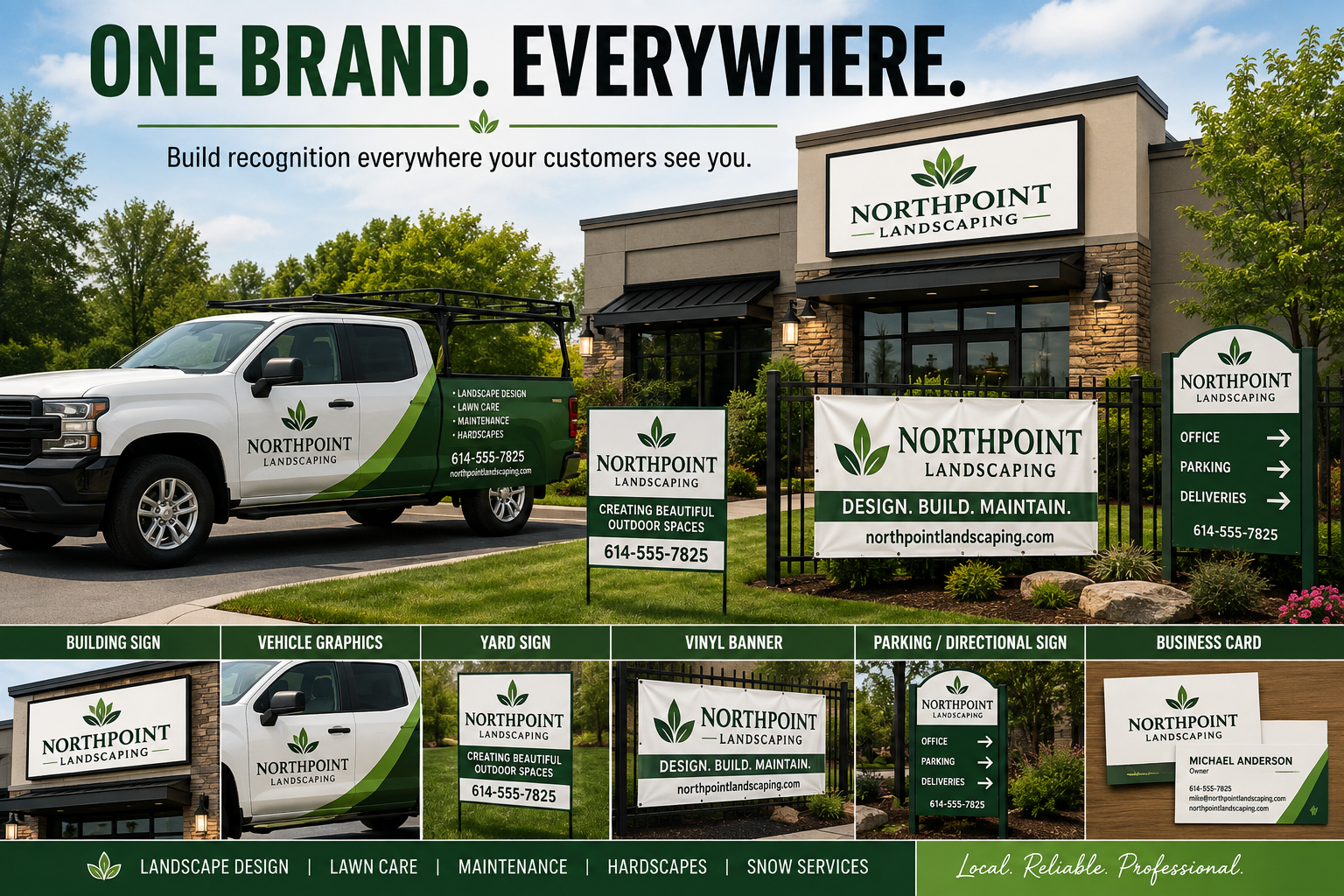
One Brand. Everywhere.
When your building, vehicles, temporary advertising, directional signage, and marketing materials all share a consistent identity, something important happens: individual signs begin working together as a larger marketing system.
A customer who repeatedly sees the same brand becomes more likely to recognize it the next time it appears.
That's why the goal isn't simply to buy more signs.
It's to create more opportunities for the right people to recognize your business.
From the Sign Shop
Think of your signage as a team rather than a collection of individual products. Each piece has its own job, but your logo, colors, message, and visual identity connect them. Start with what you need today, keep your branding consistent, and build from there.
 Stay connected!


